


Digital transformation of business is a long-standing trend. In the last two years, when millions of people had to stay home for months, this trend has accelerated significantly. Companies were looking for ways not to lose touch with their consumers, so they went online. Businesses around the world are developing their own mobile applications.
According to Statista, in the USA only, the retail m-commerce sales via smartphone would reach $3.35 trillion by 2028, which is going to make 63% of all the retail e-commerce turnover.
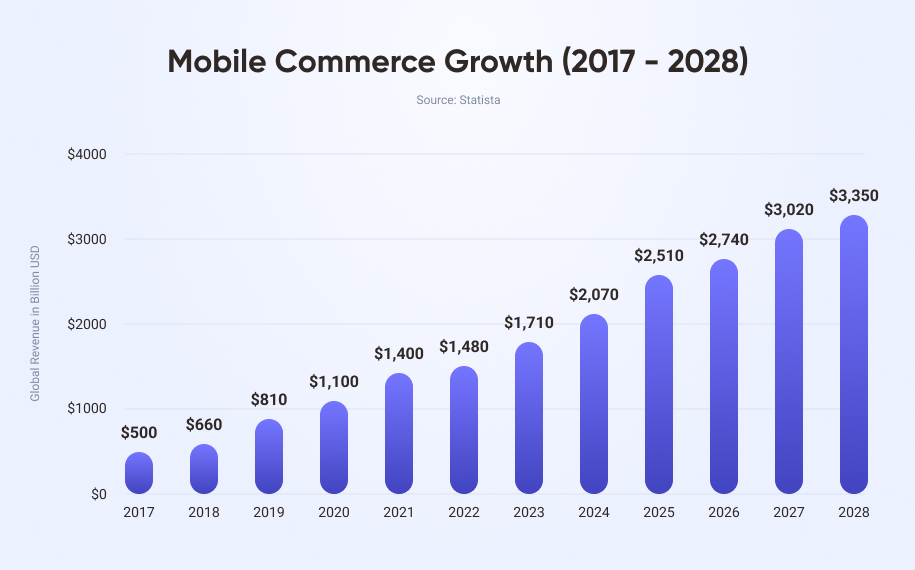
Besides, in 2025, mobile devices have generated 77% of all the e-commerce traffic, which resulted in 69% of all purchases being made through mobile devices.
Why Your E-commerce Business Needs a Mobile App
There are many benefits to creating your mobile app – or a strong alternative, such as a progressive web app for e-commerce or a headless commerce mobile app. These benefits include:
Constant stay in touch with your audience via push notifications and fast access
An affordable direct sales channel that bypasses some marketplace fees
Increased audience engagement through personalized experiences, loyalty integration, and in-app features
Easy collection of data for further analysis using mobile app analytics tools
Elevated customer retention in mobile apps via convenience and native-app-quality experience
However, one of the main disadvantages of creating your own mobile app is the high competition in this market. If you want users to install it, you’ll need to make it not only powerful and convenient, but also constantly promote it – via ASO (app store optimization), push notification marketing, loyalty program integration, and more.
But if the benefits outweigh, and you are not afraid of difficulties, then it's time to do your own business app! To make it easier for you to get started, we have written this guide.
Creating a Mobile App for Your M-commerce Success: 10 Things to Consider
Audience
First of all, you should decide on your target audience. Of course, you have been working in the market for some time and already know who your customers are. However, it’s not the fact that the same people will switch to the mobile app.
On the one hand, some of your customers will not want to install another mobile application on their phones. On the other, you get a unique chance to attract new customers who might not otherwise have known about your business.
Before you start developing an app, try to make a clear portrait of your potential online buyer. We recommend creating a brand persona: a specific person with a name, age, education, marital status, interests, and hobbies. They would become the face of your audience. They are who you create an app for. Ask yourself:
What are the interests of your brand persona?
What will motivate them to install the app?
What will push them to make a purchase?
How much are they willing to spend on your product via the app?
According to Marketing Insider Group, 93% of companies who exceed lead and revenue goals segment their database by buyer persona.
Idea and Purpose
Once you’ve outlined your audience, it’s time to turn those insights into a clear, actionable concept — the backbone of your mobile app strategy. The “idea” phase is about more than just having an app; it’s about defining its purpose, functionality, and value proposition. Ask yourself how your app will fit into your broader m-commerce strategy and how it will complement your existing digital ecosystem. For instance, is it primarily a sales channel, a loyalty hub, or a brand experience tool? The most successful apps have a distinct role that solves a real user problem while driving measurable business value.
Understanding the target audience will help you form the general idea and concept of the future app. To do this, we again recommend that you ask yourself a few questions. The answers will help understand why you need your own application and how it would provide you with the maximum benefit.
What goals do you want to achieve with the app?
What problems do you plan to solve with its release?
What should it be like to make the brand persona interested?
If your goal is to increase engagement, consider incorporating personalized recommendations or gamified elements to make shopping enjoyable. If your aim is to improve customer retention in mobile apps, focus on features like loyalty program integration, push notifications, and fast reordering. Your app’s purpose should guide design and functionality decisions — from the home screen layout to the checkout flow.
At this stage, it’s also crucial to think about mobile app monetization opportunities. Will you rely solely on product sales, or could your app include premium features, subscriptions, or advertising placements? Each model will influence your UX and technical requirements.
Don’t overlook future scalability. Maybe today your app will simply serve as a mobile storefront, but later it could evolve into a progressive web app for e-commerce or integrate with a headless commerce mobile app structure to support richer omnichannel experiences. The clearer your purpose now, the easier it will be to expand later without costly redesigns.
Finally, ensure your app’s purpose resonates emotionally with users. Your brand persona should feel that the app was made specifically for them — that it simplifies their life, saves time, or makes shopping genuinely fun. A well-defined idea doesn’t just clarify what your app does; it communicates why it matters, turning a digital tool into a vital part of your customers’ everyday habits.
Market and Competition Analysis
Once you have decided what the idea behind your app is, it is time to analyze the market and carefully study competitors. This will help you not only stand out but also avoid the mistakes they've already made.
First of all, study the top applications in relevant categories of app stores, such as Google Play Store and Apple App Store. Install your competitors' apps and try them out. Do this as thoroughly as possible, pay attention to every little thing.
Be sure to ask your employees to join the research: the more opinions, the better. You can also interview your customers. Find out what they would like to see in your future application.
After researching your competitors and talking to clients, make a list of the good and bad ideas. This information will be helpful to you when drawing up a functional specification for a future app.
For more successful e-commerce mobile app creation strategy, here’s a practical check-list with steps to do:
1) Map the landscape (who, where, how big): List direct, indirect, and substitute competitors. Note their target segments, pricing, regions, and platform focus (iOS, Android, PWA). Capture app store category ranks, downloads (estimates), rating trends, and release cadence. This shows traction and how fast each rival iterates.
2) Mine reviews for gold (and landmines): Export the last 500–1,000 reviews per competitor; tag by topic (speed, bugs, UX, payments, support). Quantify sentiment and rank top 10 “love” and top 10 “hate” themes. These become your must-builds and must-avoid pitfalls.
3) Benchmark the funnel (and set your bar): Mystery-shop each app: time-to-first-value, steps to checkout, search-to-product CTR, cart-to-checkout, checkout conversion. For customer retention in mobile apps, note their day-1/7/30 re-engagement tactics (welcome series, streaks, reminders).
4) Analyze growth levers & ASO: Check their keywords, localizations, icon/screenshot split-tests, preview video narrative. Look through UGC screenshots vs. polished studio shots to identify gaps you can own. Pay attention to cross-promotions used (email banners, web smart app banners, QR codes in packaging, influencer deep links).
5) Technology tells a story: Note signals of cross-platform mobile development (React Native/Flutter) vs. native; PWA presence; headless commerce mobile app architecture clues (API-driven, lightning releases).
6) Jobs-to-Be-Done & journey gaps: Interview a handful of your (and competitors’) customers: what “job” are they hiring the app for (discover, replenish, manage orders, get perks)? Map the journey (discover → evaluate → buy → receive → use → re-buy) and highlight friction where you can uniquely win.
7) Opportunity sizing & differentiation: Convert findings into a “value curve” chart: where the market over-serves (bells/whistles) and under-serves (speed, reliability, local payments, sustainability).
A simple template to make your m-commerce journey easier
Market snapshot: size, growth, seasonality, regulatory notes.
Competitor matrix: 8–12 players × the scoring rubric above.
Review insights: top pains to fix, top delights to emulate.
ASO audit: keyword gaps we can rank for in 60–90 days.
Differentiation thesis: 3–5 bets no one else is making.
Risks & mitigations: e.g., promo over-reliance → build loyalty tiers.
Go-to-market angles: launch partners, creators, referral mechanics, QR in packaging.
Run this process once before MVP, then lightly every quarter. It keeps your roadmap honest, your m-commerce strategy focused, and your app a step ahead of whatever the category tries next.
Functional Specification
It's time to get down to business! Any large-scale work begins with a functional specification. It should be clear, understandable, and cover all aspects of the application development. When drawing it up, be sure to consult with the developers. They will help to avoid mistakes and misunderstandings.
Don't forget to cover:
User registration and authorization
User profile and history of actions
The clear and intuitive checkout process
Variety of payment options
Products rating and reviews
Additional options: wishlist, quick checkout
Please note that the application should work equally well on the two most common platforms – iOS and Android. As for the development approach, be sure to consult with experts (they will highlight what to focus on).
Pay particular attention to UI/UX design. This means that the application should look not only nice but also be convenient and intuitive. Ensure your spec considers mobile app monetization (in-app purchases, subscriptions, affiliate integrations) and supports app store optimization (ASO) with referential metadata and usage tracking. The users should not think about where to search the section they need. Any action should be performed with a minimum number of clicks. Keep in mind that sometimes a few extra steps in the checkout process will make the buyer not come back to you.
Technical Approach: Native App, Hybrid, or PWA
Your development strategy influences cost, time to market, and performance. Options:
Native iOS + Android: high performance, best UX, higher cost
Cross-platform mobile development (e.g., Flutter, React Native): single codebase, cost-effective
Progressive Web App for e-commerce: lightweight, works in browser and installs like an app, faster and cheaper. PWAs are gaining traction — for example, brands adopting PWAs reported conversion increases and lower bounce rates.
Headless commerce mobile app: separates frontend and backend, giving ultra-flexibility for mobile experiences
Choosing the right path is key to your long-term m-commerce strategy success.
Development and the Monetization
Having written the functional specification, you can entrust the work to the e-commerce development team. If you have a large business, it will be more convenient and profitable to hire them full-time. They will support the app after its release. If you have a small company and your app is not too complex, it makes sense to find a freelance developer. For specialized financial technology solutions, partnering with a fintech app development company can provide the expertise needed to create a robust and secure application.
The cost of developing an application can be very different and depends on its complexity, the number of specialists involved in the process, and other factors such as the use of smartphone hardware features or maintenance plans. We strongly recommend not trying to save money on development. The unstable work of the app will only scare customers away and significantly spoil your image.
When planning mobile app monetization, consider: in-app exclusive discounts, mobile-only loyalty tiers, subscription services, or ad placements. Use your app as a standalone channel, not just a bot to replicate your website.
Testing
After the development stage, the testing period begins. Usually, it is done by specialists. But you shouldn't stay away either. After all, who knows your customer better than you?
Before the app's official release, be sure to repeatedly go the way the client would go. Try being in their shoes so you can see weak points and fix them before it's too late.
When the testing is over, you are ready for the Great Launch! Take a moment to celebrate it.
Launch, ASO & Promotion
The first days after the official launch are very important. To make them go smoothly, make sure that the company is ready for everything: to process orders coming through the app, provide support to users, answer their questions, and quickly resolve problems. Yes, there would be problems at the start. It is inevitable.
Also, make sure your app looks good on the app store. Select informative and nice-looking screenshots and make a concise description that will encourage the user to install it.
The launch phase is critical. Prepare your app store listing with ASO — keywords, compelling description, screenshots, video preview, reviews/ratings. Promote the app via your website, email list, social media, and offline channels. Use push notification marketing to welcome new users and drive first actions. Encourage early installs by offering app-exclusive promotions or loyalty points. Maintain momentum — an app is only as successful as your retention strategy.
Retention, Analytics & Growth
You’ve launched – now the real work begins. Track retention metrics, session length, purchase frequency, and churn. Use push notifications intelligently: personalized offers, cart-abandonment reminders, loyalty rewards. Integrate your loyalty program within the app to deepen engagement and boost customer retention in mobile apps. Use analytics to identify bottlenecks and create A/B tests for features, UX and offers. Grow your user base through referrals, app-only deals, and consistent updates.
A successful mobile app doesn’t just attract downloads – it keeps users coming back. The post-launch phase should focus on engagement loops that sustain long-term retention and increase lifetime value. Start by defining clear retention metrics: Day 1, Day 7, and Day 30 active user rates. These indicate how engaging your onboarding and early experience are. Use mobile app analytics tools like Mixpanel, Firebase, or Amplitude to track behavioral funnels — for instance, how many users who view a product actually complete a purchase. Identify where users drop off and improve those friction points.
Next, make push notification marketing an art, not an annoyance. Segment users based on behavior – send “We miss you!” reminders to inactive users, cart-recovery nudges to near-buyers, and exclusive offers to loyal customers. Time them well: too many can lead to uninstalls, but relevant, contextual notifications can increase retention by up to 190%.
Don’t forget the power of loyalty program integration. Reward repeat purchases with points, early access to new collections, or limited-time perks. Gamifying these incentives keeps users emotionally invested in your app. Tie rewards to measurable engagement goals, such as leaving a review or sharing a referral code.
Development: Headless, Loyalty, Data-Driven
The app release is not the last step. You still have a lot of work ahead of you:
Headless commerce mobile app architecture for faster feature iteration
Deeper loyalty program integration (tiered rewards, gamified points)
Use mobile app analytics tools to build predictive models for retention and monetization
Continuously refine your cross-platform mobile development approach for performance and cost efficiency
Leverage push notification marketing and in-app messaging for re-engagement
Starting from the very first days after the launch, begin collecting data on your customers' behavior. This information will help you better understand them and make the necessary improvements in the future.
Are Mobile Apps Important for E-commerce?
Yes. Creating your own mobile app for your e-commerce business is not a one-time project — it’s a strategic asset in your m-commerce strategy. From defining your audience and building the right technical foundation (native/hybrid/PWA) to optimising monetization, ASO, user retention and analytics – each step matters. The mobile landscape is dominant: as statistics show, mobile commerce and mobile apps are no longer optional – they’re essential. By investing in quality development, smart promotion, and consistent optimisation, your app can become a high-value customer touchpoint that drives sales, loyalty, and long-term growth.
The process of developing an app might seem complex, but in fact, you just need a great idea and a strong will to work thoroughly on it. We hope that you will create a perfect app, attract new customers and increase profits with our guide. For your business to receive only benefits and not problems with your app, be sure to involve professionals in its development. Good luck!